
Provenance Matters: by Jared L. Porter, MLIS, CRM, MDiv
Christmas is over, the New Year is here, and the time has come to focus on cleaning out closets, purging old stuff, and donating items. Three types of items are on my wife's perennial hitlist: my CD collection, our DVD collection, and my baseball cards. This year, I came to terms that it is time to purge my cards.
Just like many other kids that grew up in the 80s, I started collecting baseball cards and buying packs at K-Mart, card shops, and card shows. Parents and grandparents alike knew it was always a safe bet to gift a pack of cards or even a boxed set for birthdays and holidays. In fact, I came across a handwritten note from my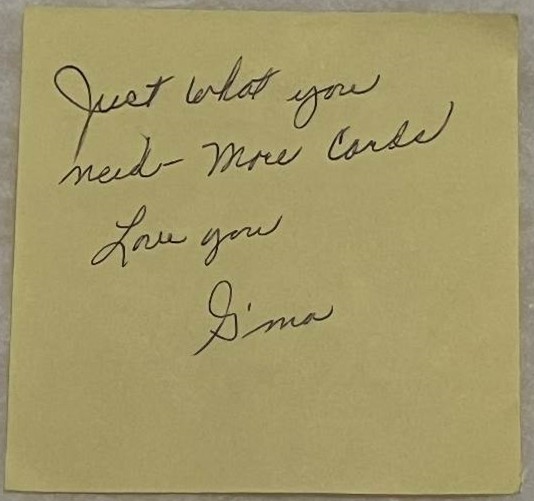 grandmother teasing me, "Just what you need--more cards." Fast forward to 2011, married with a kid and another on the way, my wife kept asking what in the world I was going to do with boxes and boxes of baseball cards that I brought into the marriage. I decided to buy a Beckett Price Guide and go through my card boxes to identify any cards worth more than the basic common cards. Everything that was worth less than $.25 in that guide got boxed up and I gave the bulk to a buddy who has a hobby of selling cards. I was feeling good about narrowing everything down to fit in a single binder and one Hammermill paper box. And now, almost 14 years later, it is time to be more ruthless and pare down the collection even more.
It is no secret that sports cards of the 80s and 90s were overproduced and now they carry the moniker "Junk Wax" so expectations for value in my 2,000 cards must be tempered. I had 600 of the cards pegged at $1 or more in 2011 so hopefully some of those values would hold. As a librarian and records manager by trade, I wanted to do some research to see if I could come up with a price that my collection would be worth and where I might be able to sell it. Lo and behold, when reaching out to the same family friend I donated cards to years ago, he invited 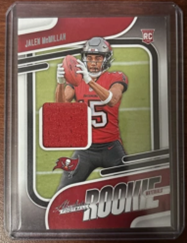 me to join him in selling at his table at an upcoming card show. Research mode really kicked in then: how do I need to organize, what are current market rates, etc. YouTube provided a vast array of perspectives of vendors and collectors and has given me excellent insights into how to put my best foot forward at the show. And then something very interesting came up in my research: card relics and provenance. My hobbies of decluttering and baseball cards have led me back to a concept from my day job.
Definitions
Card collectors and RIM professionals are not equipped with the same lexicon. Before jumping into the crux of the argument, here is the definition of a relic card from an industry professional, Geoff Wilson, owner of Cards HQ: "Some cards will also feature relics which is a piece of the player's jersey or a piece of memorabilia, such as a piece of the player's glove, or a bat." (Wilson, 2025)
From the records and information management side of the house, here is the definition of provenance: "The origin or source of something. Information regarding the origins, custody, and ownership of an item or collection." (Franks, 2018)
The Problem
What I came across in my research is that collectors were finding that relic cards contained jerseys patches or other memorabilia that were not even associated with the player on the card. How did they come to these conclusions? They started destroying the cards! Some card collectors were led to believe that the relic is from the specific player on the card when it really was not. Once other collectors got wind of this, they began pulling out their relic cards and literally pulled them apart to see 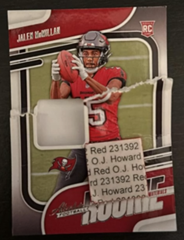 what information was on the back of the patch or relic. Some card companies, such as Panini, would label the back of the relic with a player name and a number. When one collector opened a rookie card relic from Jalen McMillen, the relic said another player's name on the back: O.J. Howard. Was the card incorrectly identified? Was the chain of custody broken and McMillen's jersey lost or placed in another card? Who is responsible for this? How many other relic cards are like this? Can anyone trust sports card companies again?
Records managers understand that destruction is a part of the records lifecycle; however, traditional sport cards are more closely related to permanent records or archival materials which do not have a scheduled end-of-life. Archivists and records managers care deeply about provenance and tracking materials from primary/original sources to their current locations. In personal collections, items can be passed down to relatives through the estate or documented in a will. In a corporate environment, materials can be passed down based upon office or position when there is attrition, or simply traverse business processes from one office to another in a document workflow. For records that matter, knowing where they originated and the pathways they travel are important--especially if the document's validity might be scrutinized in litigation or another significant arena. Confidence is compromised when origins are unknown, or provenance is suspect.
The Solution
Apparently questioning relic cards circulated as a forum and social media topic in 2020 and is now resurfacing in some collector circles/social media crazes. In the meantime, sports card companies have begun articulating on the card what type of relics are included. Many now state what type of relic is being used. Wilson (2025) continues:
Now the quality of the relic makes a big difference. A piece of a player's jersey that contains part of a patch of a jersey, such as a team logo, the player's number, the Nike Swoosh, or the most highly sought after patch: the NBA Logoman, the NFL Shield, the NHL Shield, the MLB Logo, or MLB Debut Patch, those are the most valuable. Ideally, the relic or jersey patch is 'game-worn' meaning the player wore or used that item in an actual game. The card will tell you if it's game-worn or not often right around where the relic or jersey patch is or on the back of the card. You may instead see that an item was player-worn or event-worn, which means that the player did wear the item but not during a game. Typically, these relics come from jerseys that the player tries on during a photo shoot or in an autograph signing sessions. The final type of relic are those that are not associated with a particular player or event which means that the player never actually touched the item. It was just a store-bought jersey or hat that was chopped up and put into the card. Those are definitely less desirable because while they're nice to look at in the card, they have no connection with the actual player on the card.
It is unreasonable for a card company to list the entire chain of custody of a relic and report all that on rectangular cardboard 2.5" x 3.5"; however, this metadata should be captured in a record somewhere. Card companies are taking steps to be more forthright about what type of relics they are using. It is up to the collectors to interpret the fine print on cards and assign both expectations and value to whether the relic is directly associated with the shown player. The onus is on the consumers with card company statements such as these: "The enclosed official licensed material is not associated with any specific player, game, or event." Or "The enclosed game-worn/used material, which was worn/used as a member of the Oklahoma City Thunder, is guaranteed by Panini America, Inc."
Overall, provenance does matter. It matters in records management, and hobbyists have spoken that it matters in sports card collecting. Who knew that our annual winter cleaning would uncover this intersectionality between these two diverse interests!
References
Dan the Card Man. (2025, January 6). Fake Panini Sports Card Patches--Why are we surprised? (2025). YouTube.
https://www.youtube.com/watch?v=l2D0VQXKbW8
Davimorg314-4. (2025, March 17). 2024 Panini Absolute Rookie Material Patch Jalen McMillan #ARM-JMN RC Buccaneers (2025). eBay.
https://tinyurl.com/ARM-JMN-RC
Franks, P. C. (2018). Records and Information Management: Second edition. American Library Association. 431.
Wilson, G. (2025, January 19). Sports Card Investing & Collecting for Beginners: Everything You Need to Know (2025). YouTube. https://youtu.be/hc7DS4gkM2o?si=s0vCtbOA3AeGaHFN&t=1447